

INTERNATIONAL WOMEN IN MULTIPLE SCLEROSIS
A supportive and inspirational community for women and minorities
working in the field of Multiple Sclerosis.

Facilitate and foster scientific collaborations through iWiMS Scientific & Clinical Interest Groups
Winner of the 2025 Rachel Horne Prize for Women's Research in MS
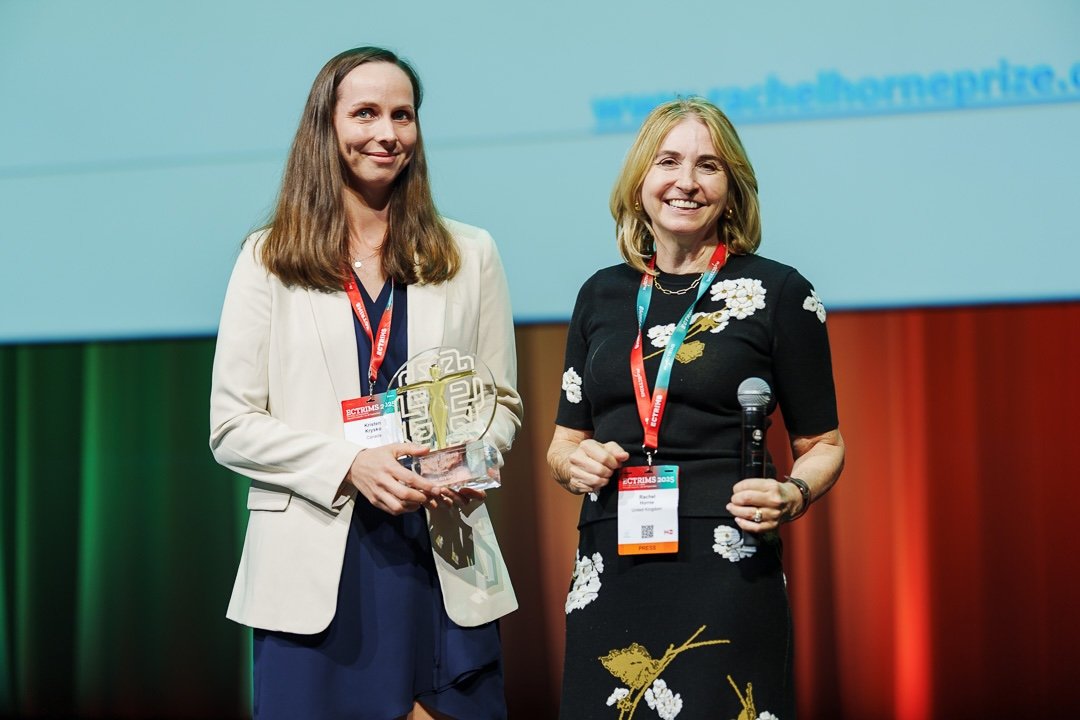
Photo © ECTRIMS 2025
Dr. Kristen Krysko, a Canadian neurologist, researcher, and clinician, has been awarded the 2025 Rachel Horne Prize for Women’s Research in Multiple Sclerosis. This prestigious recognition honors Dr. Krysko’s outstanding research on how best to guide and treat women with MS during pregnancy and breastfeeding.
2026 Rachel Horne Prize for Women’s Research in MS
The Rachel Horne Prize for Women’s Research in MS recognizes senior women scientists and neurologists for their outstanding contribution to women’s health-related research in multiple sclerosis (MS).
The prize is awarded annually and provides US$40,000, to be used at the recipient’s discretion. The 2026 winner will be announced and presented with the award at the 10th Joint ACTRIMS-ECTRIMS Meeting in Toronto (October 2026).
Key dates
Nominations/applications open: March 8, 2026
Nominations/applications close: June 12, 2026
Learn more: Full details, including eligibility and how to apply, are available at rachelhorneprize.com.
iWiMS Webinar Series: Charting Your Early Career in Multiple Sclerosis
This activity is supported by an educational grant from EMD Serono, Inc.
iWiMS is excited to offer a four-part webinar series, Charting Your Early Career in Multiple Sclerosis, geared towards neurology residents, fellows, early-career faculty, and those considering a new position. Expert speakers will discuss their personal career journeys and share insights and resources on professional development and growth
Latest Meeting Recordings


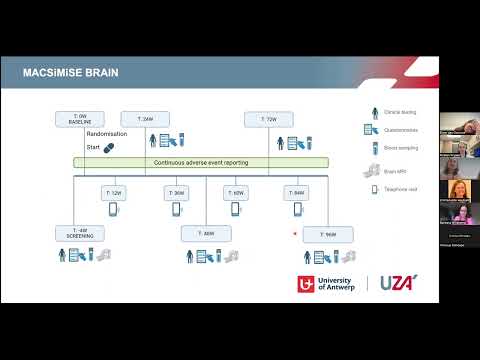


This recording from Thursday, 27 November 2025 features leading international experts who discuss the importance of accurate assays for diagnosing AQP4-NMOSD and MOGAD, explore regional assay availability, and share innovative approaches for sample testing and disease monitoring.
Agenda:
Welcome and introduction – The importance of having accurate assays for the diagnosis of AQP4-NMOSD and MOGAD - Sara Samadzadeh (Germany/Denmark)
Current assays available for testing (assay availability survey) - Patrick Waters (UK)
Q&A – Regional perspectives on assay availability- Adriana Casallas Vanegas (Colombia/Spain) & Sanja Glucevic (Montenegro)
Sample types and testing approaches: CSF vs. serum for AQP4-NMOSD and MOGAD - Sara Mariotto (Italy) - Other approaches and experiences (Rapid IDOT)
Other approaches and experiences (Rapid IDOT) - Rui Li (China)
Limited availability of Live CBA for AQP4-IgG testing in LATAM countries - Vinícius Boldrini (Brazil)
Closing and wrap-up